Best Time to See the Northern Lights in Finland
Successful aurora chasing requires the alignment of three critical elements: dark skies, clear weather, and sufficient geomagnetic activity. While solar wind disturbances occur all year round, Finland's 24-hour midnight sun during summer makes auroras invisible from May through late July. Here is your definitive guide to the best seasons, months, and hours to see the Northern Lights.
⚡ Key Takeaways / Quick Summary
- The aurora season in Finland spans from late August to mid-April. Summer midnight sun prevents sightings completely.
- Statistical activity peaks around the autumn and spring equinoxes (September–October and March–April) due to the Russell-McPherron effect.
- The most fruitful viewing hours are usually between 21:00 and 02:00 around magnetic midnight.
1. The Aurora Season: Late August to Mid-April
In Finnish Lapland, the Northern Lights season begins in late August, as twilight returns to the northern latitudes. The season stretches through autumn and winter, concluding around mid-April when twilight hours lengthen again.
Contrary to a widespread myth, freezing winter cold does not create auroras – the phenomenon takes place 100 km up in space regardless of ground temperature. However, cold winter nights often coincide with high-pressure systems and crystal-clear skies, providing ideal spotting conditions.
2. September & March: The Equinox Peaks
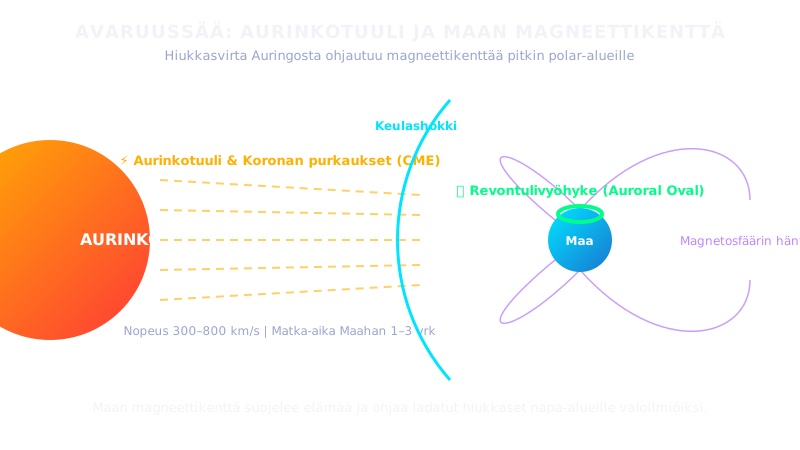
Long-term geophysical statistics reveal that the most active aurora months of the year are September, October, and March. This peak is caused by the Russell-McPherron effect.
Around the autumn and spring equinoxes, the geometry of Earth's magnetic dipole tilts favorably with the interplanetary magnetic field (IMF), facilitating stronger reconnection and channeling solar particles into the polar atmosphere. In September, unfrozen lakes also create mirror-like reflections of the dancing lights on calm water.
3. Peak Nighttime Hours: 9:00 PM to 2:00 AM
While auroral substorms can flare up as soon as darkness falls, the highest probability occurs around magnetic midnight. In Finland, magnetic midnight occurs roughly an hour before or after standard midnight (between 11:00 PM and 12:30 AM in Lapland).
During major geomagnetic storms (Kp 6 to 8), auroras can remain active continuously from dusk until the early dawn hours.
4. Moon Phases: New Moon vs. Full Moon
The moon impacts the visual experience in two distinct ways:
- New Moon / Dark Skies: Ideal for spotting faint, delicate aurora arcs. The contrast against the black night sky is strongest.
- Half or Full Moon: Bright moonlight illuminates snowy fells, frozen trees, and the foreground landscape, making it safer to hike and providing photographic depth. Strong auroras easily outshine moonlight.
5. Pro Tips for Aurora Seekers
- Monitor real-time cloud cover: Use Aurora Cast's live map and 48-hour timeline before heading out into the night.
- Escape city light pollution: Driving just 5–10 minutes away from town centers dramatically improves contrast.
- Face north: During periods of lower solar activity (Kp 1–2), the aurora band often hovers along the northern horizon.
- Dress for extreme conditions: Substorms can ignite suddenly after hours of calm. Wear thermal layers and bring warm drinks.
Scientific references:
- Finnish Meteorological Institute - Auroral statistics and space weather in Finland.
- NOAA Space Weather Prediction Center - The Russell-McPherron effect and equinoctial geomagnetic peaks.