Colors of the Northern Lights – What Causes the Hues?
The Northern Lights are celebrated for their iconic emerald green glow, yet during intense geomagnetic storms, the night sky can burst into crimson red, deep violet, and vibrant electric blue. The specific colors produced depend on two fundamental physical variables: which atmospheric gas is colliding with energetic electrons, and at what altitude those collisions occur.
⚡ Key Takeaways / Quick Summary
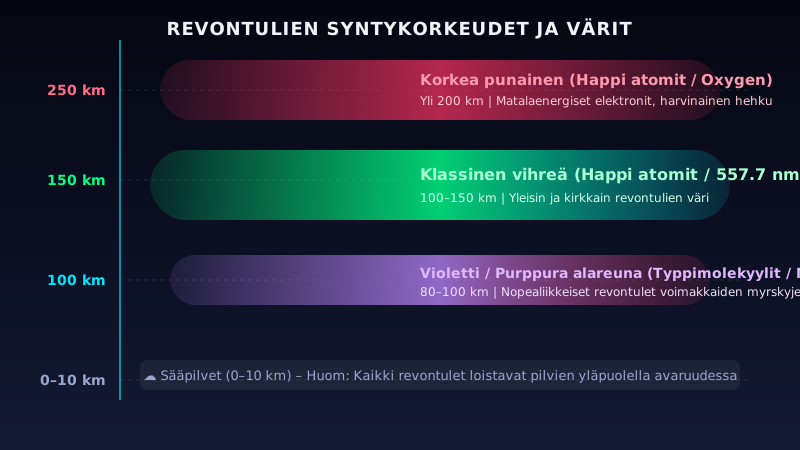
- Green (557.7 nm) is the most prominent color, created by excited atomic oxygen between 100 and 150 km altitude.
- Intense geomagnetic storms excite molecular nitrogen, creating stunning purple, pink, and magenta curtains at low altitudes (80–100 km).
- High-altitude red auroras (>200 km) occur during low atmospheric pressure when oxygen releases 630 nm light over longer relaxation times.
1. Emerald Green (557.7 nm) – The Signature Glow
Approximately 90% of all observed auroras display a vibrant green coloration. This light is emitted when incoming magnetospheric electrons collide with atomic oxygen (O) at altitudes between 100 and 150 kilometers (60 to 90 miles).
The collision excites oxygen atoms to higher quantum energy states. As they relax back to their ground state, they release that surplus energy as green photons at a wavelength of 557.7 nanometers. Because human night vision is most sensitive around the green portion of the spectrum, green auroras are by far the easiest to spot with the naked eye.
2. Crimson Red (630.0 nm) – High-Altitude Rarity
Deep red auroras also originate from atomic oxygen, but at much higher altitudes: between 200 and 300 kilometers (120 to 180 miles).
The transition that produces the 630.0 nm red photon is a "forbidden transition" that takes up to 110 seconds to occur. At lower altitudes, collisions with other molecules would de-excite the atom before a photon could escape. Above 200 km, the atmospheric density is thin enough for the red glow to radiate freely. Because of their towering height, red auroras can be visible across vast distances, often appearing low on the northern horizon across southern Finland and central Europe.
3. Purple, Violet, and Blue – The Signature of Nitrogen
When solar wind particles possess extraordinarily high kinetic energy, they plunge deeper into the atmosphere down to 80 to 100 kilometers. At this denser atmospheric boundary, particles collide with molecular nitrogen (N₂) and ionized nitrogen (N₂⁺).
Nitrogen excitation yields vivid violet, royal blue, and magenta-purple fringes. These intense colors typically ripple along the lower borders of rapidly undulating curtains during peak substorms and corona explosions.
4. Why the Human Eye Sees Colors Differently Than a Camera
First-time skywatchers are often surprised that faint auroras appear whitish or light gray to the naked eye, while the photographer's camera preview shows brilliant green and pink hues. This is rooted in human biology:
- Rods (Scotopic night vision): In low light, our retinas rely on rod photoreceptors. Rods are extremely light-sensitive but cannot perceive color, registering only shades of gray.
- Cones (Photopic color vision): Color-sensitive cones require significant photon intensity to trigger. Only when auroras become exceptionally bright do our eyes perceive vibrant saturation directly.
- Camera Sensors: Modern camera sensors accumulate light over multi-second exposures, easily collecting enough photons to saturate raw image channels with vivid colors.
Scientific references:
- Sodankylä Geophysical Observatory - Auroral spectroscopy and excitation states.
- NOAA Space Weather Prediction Center - Upper-atmospheric emissions and auroral dynamics.