What are the Northern Lights and how do they form?
The Northern Lights (scientifically known as Aurora Borealis in the Northern Hemisphere) are one of nature's most spectacular light shows. While they look magical, the phenomenon is driven by fascinating space physics originating 150 million kilometers away on the Sun.
⚡ Key Takeaways / Quick Summary
- Auroras form when solar wind particles collide with oxygen and nitrogen atoms in Earth's upper atmosphere (80–300 km).
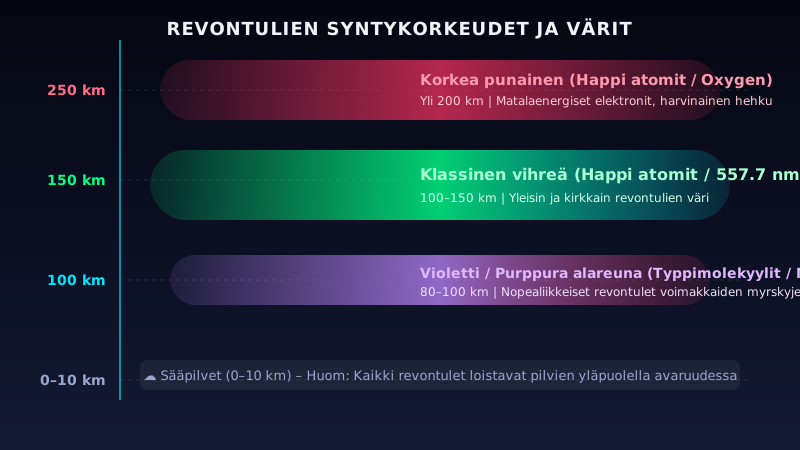
- Green is the most common color (excited oxygen at 100–150 km); strong geomagnetic storms produce vibrant purple and red lower borders.
- Spotting auroras requires monitoring the Kp index, solar wind speed, and the southward IMF Bz magnetic direction.
1. It All Begins on the Sun
The Sun constantly releases electrically charged particles (protons and electrons) into space. This stream of particles is called the solar wind. Violent solar eruptions, such as coronal mass ejections (CMEs) on the Sun's surface, can drastically intensify the solar wind, sending dense and high-speed particle clouds towards Earth.
2. Earth's Magnetic Shield
When these charged particles reach Earth (usually after traveling for 1 to 3 days), they collide with Earth's magnetic field (the magnetosphere). Our magnetic field acts as a protective shield, redirecting most of the particles around the planet. However, some particles get trapped in the magnetic field lines and are guided towards the magnetic poles – the Northern and Southern polar regions.
3. Collisions in the Atmosphere Generate Light
As the solar particles plunge into Earth's atmosphere at altitudes of about 80–300 kilometers, they collide with gas molecules (mostly oxygen and nitrogen). These collisions excite the atmospheric atoms, giving them extra energy. As they return to their ground state, they release this energy as light. Billions of these tiny collisions create the dancing auroral drapes we see in the night sky.
"Auroras work in a very similar way to neon signs or fluorescent lights—electrical energy excites gases, causing them to glow, but in this case, it happens on a planet-wide scale in space."
Why are Auroras different colors?
The colors of the aurora depend on which gas molecules the particles collide with, and at what altitude:
- Green (most common): Caused by particles colliding with oxygen atoms at lower altitudes (around 100–150 km).
- Pink/Violet lower borders: Caused by nitrogen molecules at very low altitudes (around 80–100 km) during intense geomagnetic storms.
- High Altitude Red: A very rare color caused by oxygen atoms at extreme altitudes (above 200 km) during weaker solar winds.
How can you predict Auroras?
Aurora activity is predicted using the **Kp index**, which measures global disturbances in Earth's magnetic field on a scale of 0 to 9. The higher the Kp value, the stronger the geomagnetic storm and the further south auroras will be visible. The Aurora Cast service provides live Kp index forecasts and local cloud cover percentages to help you plan your stargazing nights successfully.
Scientific sources and references:
- NOAA Space Weather Prediction Center (SWPC) - Auroral Activity Models.
- Finnish Meteorological Institute - Space weather and magnetic measurements.