Geomagnetic Storms and Space Weather
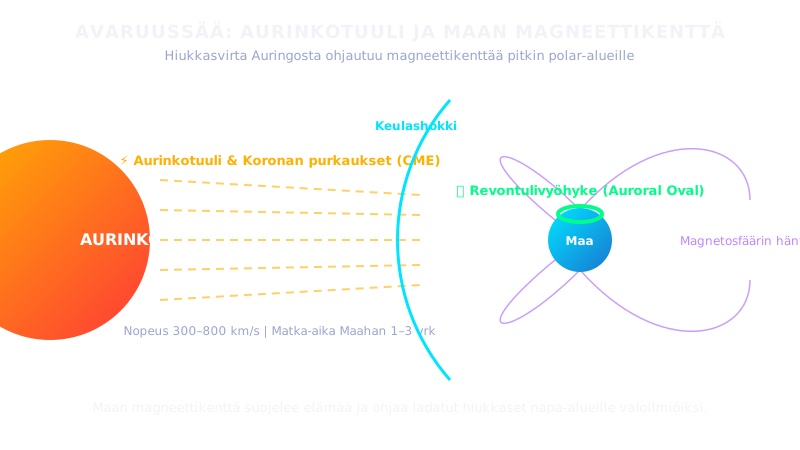
The Northern Lights are not merely a meteorological curiosity; they are the visual culmination of dynamic magnetic interactions between the Sun and Earth. This interconnected field of physics is known as space weather. When massive solar eruptions or ultra-fast solar wind streams buffet Earth's magnetosphere, they spark a geomagnetic storm that channels billions of charged energetic particles into our upper atmosphere.
⚡ Key Takeaways / Quick Summary
- A geomagnetic storm occurs when coronal mass ejections (CMEs) or fast solar wind streams compress and perturb Earth's magnetic shield.
- NOAA rates storms from G1 (Minor, Kp 5) up to G5 (Extreme, Kp 9).
- Severe storms (G3–G5) push the auroral oval south across the entirety of Finland and into central Europe.
1. Solar Cycle 25 and Sunspots
Solar magnetic activity ebbs and flows in an approximately 11-year cycle. At the peak of this cycle, known as solar maximum, complex twisted magnetic fields on the Sun's surface manifest as dark sunspot groups. These sunspots act as active launchpads for intense solar flares and plasma explosions.
Current Solar Cycle 25 has proven to be significantly more active than initial scientific projections. During solar maximum years, frequent solar storms push the auroral oval far south of the Arctic circle, offering spectacular night sky displays across Southern Finland, the British Isles, Central Europe, and mid-latitude United States.
2. Storm Origins: CMEs vs. Coronal Holes
Space weather disruptions largely originate from two distinct physical phenomena on the Sun:
- Coronal Mass Ejections (CMEs): Explosive events where billions of tons of magnetized solar plasma are hurled into interplanetary space at velocities reaching 1,000 to over 3,000 km/s. When oriented directly towards Earth (known as Earth-directed or "halo" CMEs), they trigger rapid, dramatic geomagnetic storms (Kp 7–9) within 15 to 48 hours.
- Coronal Holes (CH HSS): Cooler, lower-density regions in the solar corona where open magnetic field lines extend freely into space. High-speed solar wind streams escape continuously along these pathways (500–800 km/s). These produce reliable, moderate auroral substorms (Kp 4–6) that recur roughly every 27 days in sync with solar rotation.
3. IMF Bz: The Magnetic Gateway
Even when solar wind density and velocity are exceptionally high, auroras may remain muted without an essential condition: the orientation of the Interplanetary Magnetic Field (IMF). The vertical direction is measured by the Bz component (in nanoteslas, nT):
⚠️ Bz Pointing North (+, Positive):
Earth's magnetic shield and the incoming solar magnetic field align in parallel. Like identical magnetic poles, they repel. The solar wind is deflected around Earth's magnetosphere, keeping aurora activity subdued.
✨ Bz Pointing South (–, Negative):
The opposing magnetic fields tear and merge through a process called magnetic reconnection. Earth's magnetic doors swing open, funneling solar plasma directly into the polar upper atmosphere. The more negative the Bz value (e.g. -10 nT to -30 nT) and the longer it remains south, the more explosive the auroral display becomes.
4. NOAA G-Scale & Terrestrial Impact
NOAA classifies geomagnetic storms using a 5-point scale (G1 to G5) mapped directly to planetary Kp-index readings:
| Scale | Kp Index | Aurora Visibility | Technological Impact |
|---|---|---|---|
| G1 (Minor) | Kp 5 | Overhead across Northern Scandinavia, visible on southern horizon in mid-Finland | Weak power grid fluctuations, minor satellite operations impact |
| G2 (Moderate) | Kp 6 | Overhead in Central Finland; visible across Helsinki and southern Baltic coasts | High-latitude power transformer alarms, HF radio fadeouts |
| G3 (Strong) | Kp 7 | Overhead across Southern Finland; visible down to Denmark, Poland, and Northern Germany | False alarms on protection devices, satellite orientation corrections needed |
| G4 (Severe) | Kp 8 | Visible across Central Europe and northern United States | Widespread voltage control problems, degraded GPS/GNSS satellite precision |
| G5 (Extreme) | Kp 9 | Visible down to the Mediterranean and sub-tropical latitudes (rare) | Widespread power grid collapse risks, extensive satellite anomalies |
Scientific References & Data:
- NOAA Space Weather Prediction Center - Geomagnetic Storm Scales & Space Weather Dashboards.
- Finnish Meteorological Institute (FMI) - Space weather and geomagnetic observatory network in Finland.